
Last updated: 17 October 2026 · By Pparas Binndal, Founder, Phinzu Studio
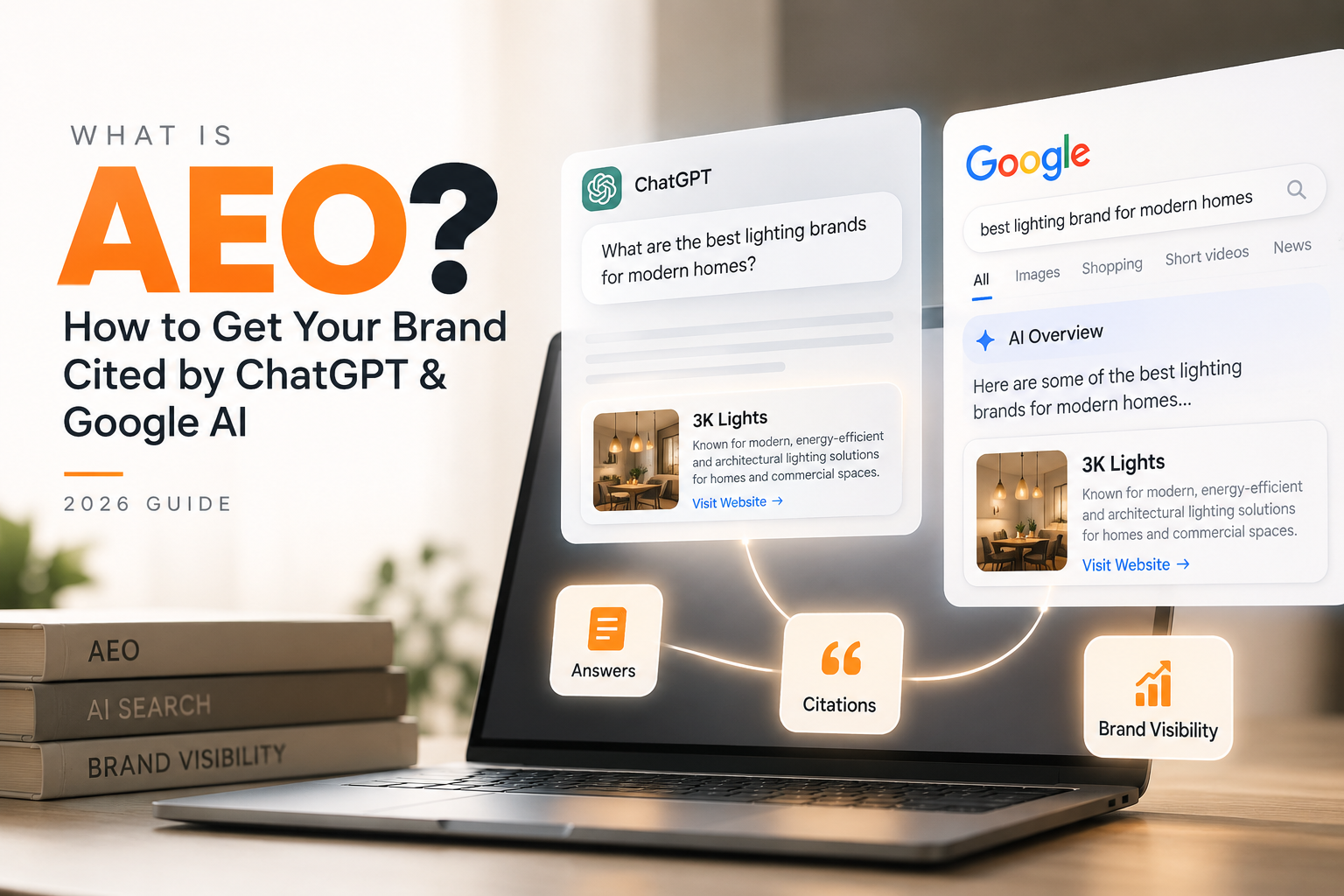
Answer Engine Optimization (AEO) is the practice of structuring your website content so that AI-powered answer engines such as ChatGPT, Google AI Overviews, Gemini and Perplexity can understand it, trust it and quote it in their answers. Traditional SEO helps you rank as a blue link. AEO helps your brand become the answer itself. For Indian businesses, this means writing clear, direct answers to the questions your customers actually ask, and backing them with structured data and real expertise.
Key Takeaways
- AEO gets your content quoted inside AI answers, not just listed as a link.
- Answer engines prefer a direct 40–60 word answer at the top of a page, followed by detail.
- Question-style headings, FAQs, lists and schema markup make your content easy for AI to extract.
- Trust signals (author, real experience, updated dates, brand mentions) decide whose answer gets cited.
- AEO does not replace SEO. It builds on top of a technically healthy, indexable website.
What is AEO (Answer Engine Optimization)?
AEO is optimizing content for answer engines rather than only for search result rankings. An answer engine reads many pages, then writes one combined answer for the user. Your goal is to be one of the sources it reads, trusts and cites.
Think of a user in Delhi asking ChatGPT, “Which is better for a new D2C brand, Meta Ads or Google Ads?” The AI does not show ten links. It writes a short answer and may mention a few brands or sources. AEO is the work that makes your page the one it pulls that answer from.
How is AEO different from SEO?
SEO and AEO share the same foundation, but they aim at different outcomes.
- SEO aims to rank your page high in Google’s list of results so people click through.
- AEO aims to have your content quoted or summarised directly inside an AI-generated answer.
- SEO rewards keywords, backlinks and page experience.
- AEO additionally rewards clarity, direct answers, structure, and how trustworthy and specific your information is.
In practice, you need both. A page that Google cannot crawl or index will rarely be used by AI systems either.
What is GEO, and how is it related?
GEO (Generative Engine Optimization) is a closely related term. It usually refers to optimizing for generative AI results such as Google AI Overviews. AEO and GEO overlap heavily: both focus on making content easy for AI to extract, summarise and attribute. Many marketers use the two terms interchangeably.
Why does AEO matter for Indian businesses in 2026?
More people now start their research by asking an AI assistant or reading the AI summary at the top of Google. When that summary answers the question fully, fewer people scroll down to click a result. If your brand is not part of that answer, you lose visibility even if you still rank on page one.
This matters most for service businesses where buyers ask questions before they buy: agencies, clinics, financial advisors, education, real estate and D2C brands. Being cited by an AI answer works like a recommendation, and recommendations convert.
How does an answer engine choose which content to quote?
No AI company publishes an exact formula, but the patterns are consistent. Answer engines tend to favour content that:
- Answers the question directly in the first few lines, without a long introduction.
- Is clearly structured with question-style headings, short paragraphs, bullet points and numbered steps.
- Is specific, with real numbers, examples, prices, timelines or steps rather than vague claims.
- Shows trust signals such as a named author with experience, an “updated on” date and an identifiable business.
- Is technically accessible: indexable, fast, mobile-friendly and served over HTTPS.
- Uses structured data (schema markup) that labels what the page is about: an article, an FAQ, a business, a how-to.
How do you optimize your website for AEO? (Step-by-step)
- List the real questions your customers ask. Use sales calls, WhatsApp chats, Google’s “People also ask” and AI tools to collect them.
- Write a 40–60 word direct answer at the top of each page. Lead with the answer, then explain.
- Turn your H2 headings into questions. For example: “How much does a website cost in Delhi?” instead of “Pricing”.
- Open every section with a one or two sentence answer, then add detail, examples and lists.
- Add an FAQ section with 5–8 questions and concise answers, and mark it up with FAQ schema.
- Add Organization or LocalBusiness schema with your name, address, phone, logo and social profiles so AI systems can identify your brand.
- Show who wrote the content. Add an author name, role and experience, and keep a visible “last updated” date.
- Fix the technical basics. Make sure pages are indexed in Google Search Console, load quickly on mobile and have a clean sitemap.
- Build brand mentions off your site. Profiles and articles on LinkedIn, Medium, industry directories and news sites help AI systems recognise you as a real, trusted entity.
- Refresh important pages every few months. Update facts, add new questions and change the updated date.
What does an AEO-friendly page look like?
A simple structure that works well for most service and blog pages:
- H1 with the main question or topic
- A bold 40–60 word direct answer
- A short “Key Takeaways” box
- 4–8 sections with question-style H2 headings, each starting with a direct answer
- Lists, steps or a comparison table where useful
- An FAQ section with schema
- Author details and a clear call to action
This article itself follows that structure, so you can use it as a template.
What are common AEO mistakes to avoid?
- Long, story-style introductions before the actual answer.
- Vague headings such as “Our Approach” that do not say what the section answers.
- Thin pages with no specifics, numbers or examples.
- No author, no date and no business details, so the content looks anonymous.
- Ignoring technical health: hacked, slow or non-indexed pages will not be cited.
- Keyword stuffing. AI systems understand natural language and synonyms; write for humans.
How long does AEO take to show results?
Most sites need 4–12 weeks after optimization before they start appearing in AI answers, depending on how established the domain is and how competitive the topic is. Track progress by checking Google Search Console impressions for your target questions and by searching those questions in ChatGPT, Gemini and Google every two weeks.
Frequently Asked Questions
What does AEO stand for?
AEO stands for Answer Engine Optimization. It is the process of optimizing website content so that AI answer engines like ChatGPT, Google AI Overviews, Gemini and Perplexity can understand, trust and quote it when answering user questions.
Is AEO replacing SEO?
No. AEO builds on SEO rather than replacing it. Answer engines still rely on pages that are crawlable, indexed, fast and trustworthy. Good technical SEO is the foundation, and AEO adds clear answers, structure and schema so AI systems can use your content.
What is the difference between AEO and GEO?
AEO focuses on answer engines in general, while GEO (Generative Engine Optimization) usually refers to generative AI results such as Google AI Overviews. In practice the tactics are almost the same: direct answers, question-based structure, schema markup and strong trust signals.
Does schema markup help with AEO?
Yes. Schema markup labels your content in a machine-readable way, such as FAQ, Article, HowTo or LocalBusiness. It does not guarantee a citation, but it makes it easier for search engines and AI systems to understand what your page covers and who published it.
Can a small business do AEO?
Yes. Small and local businesses often have an advantage because they can answer very specific questions about their city, niche and pricing. Start by adding direct answers and FAQs to your top five pages, then add schema and keep them updated.
How do I check if ChatGPT or Google AI mentions my brand?
Search your most important customer questions in ChatGPT, Gemini, Perplexity and Google every two weeks and note whether your brand or website is mentioned or linked. In Google Search Console, watch impressions for those questions to see whether your visibility is growing.
Want your brand to show up in AI answers?
At Phinzu Studio, we combine technical SEO, AEO-focused content and schema to help brands get found on Google and cited by AI assistants. Explore our SEO services in Delhi, see our recent work, or book a free strategy call.