
Last updated: 17 October 2026 · By Pparas Binndal, Founder, Phinzu Studio
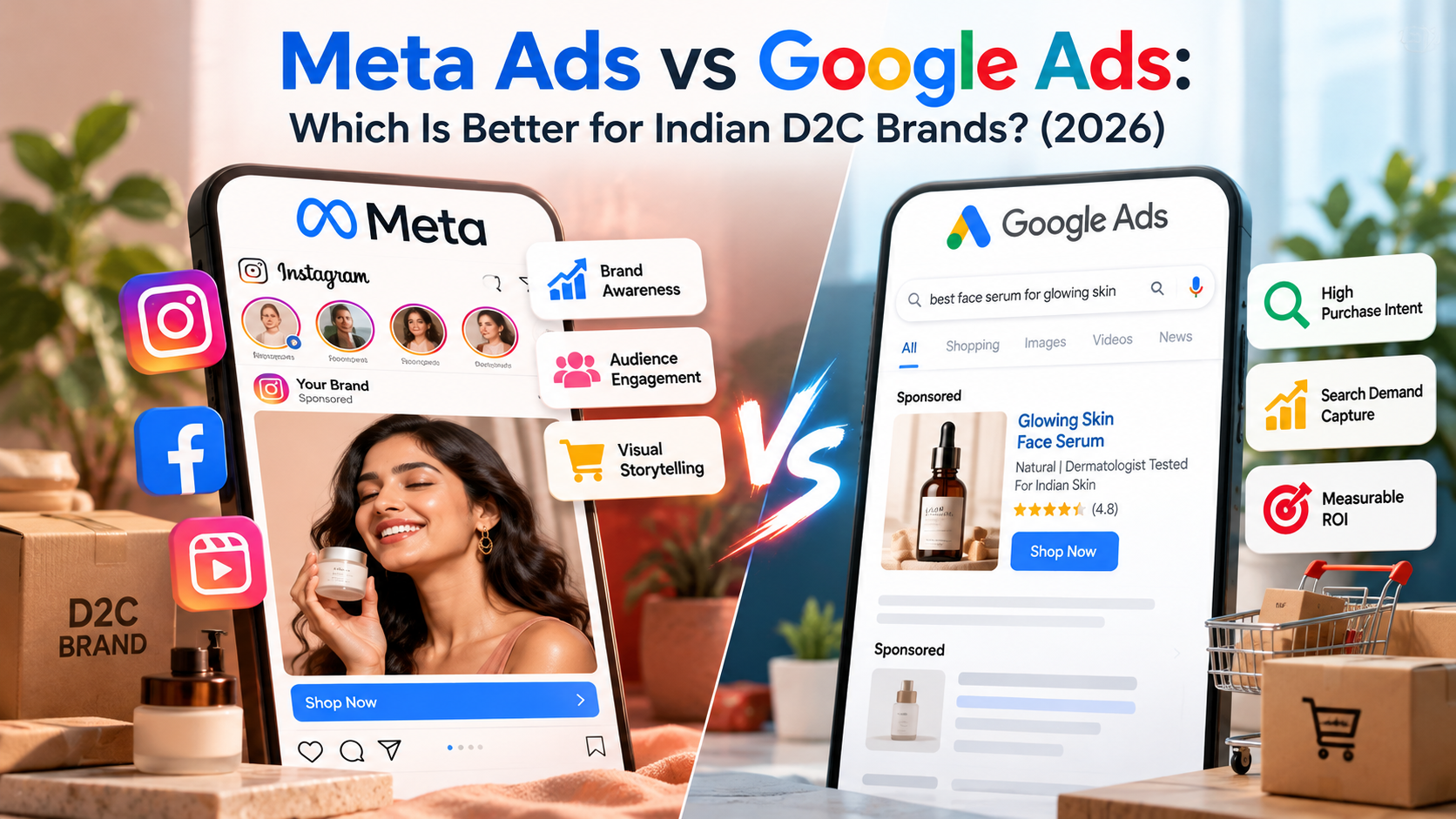
For most new Indian D2C brands, Meta Ads (Facebook and Instagram) is the better place to start, because it creates demand and builds an audience for products people are not yet searching for. Google Ads works best once people already search for your product or brand. The strongest D2C brands use both: Meta to create demand, Google to capture it.
Key Takeaways
- Meta Ads = demand creation. Best for visual, impulse-friendly and new-category products.
- Google Ads = demand capture. Best when people already search for what you sell.
- Start with the platform that matches your product’s search demand, not the one competitors use.
- Track profit, not just ROAS: factor in COD, RTO, discounts and shipping.
- Once you have steady sales, run both and let each platform do its job in the funnel.
What is the main difference between Meta Ads and Google Ads?
Meta Ads show your product to people based on who they are and what they like, while Google Ads show your product to people based on what they are actively searching for.
- Meta Ads (Facebook, Instagram, Reels): interruption-based. People are scrolling, not shopping. A strong creative stops the scroll and creates a want.
- Google Ads (Search, Shopping, Performance Max, YouTube): intent-based. People type what they need, and your ad appears as the answer.
Think of Meta as the shop window on a busy street and Google as the shop someone walks into because they were already looking for it.
When should a D2C brand choose Meta Ads first?
Choose Meta Ads first when your product is visual, new, or solves a problem people do not search for yet.
- Fashion, jewellery, home decor, beauty and personal care
- Nutraceuticals and wellness products with a strong story or “before and after”
- New categories where search volume is low (for example, a new type of collagen drink)
- Products where a 15–30 second Reel can show the benefit clearly
Meta also helps you learn fast. Testing 5–10 creatives quickly tells you which hooks, offers and audiences actually sell.
When should a D2C brand choose Google Ads first?
Choose Google Ads first when customers already search for your product, category or brand name.
- Problem-solving products people search for, such as “orthopedic mattress for back pain” or “water purifier for home”
- Products with clear comparison intent (“best … under 2000”)
- Brands that already get searches for their own name, where Brand Search campaigns are usually the cheapest sales you will get
- Catalogues that suit Google Shopping, where people compare prices and products
A quick check: use Google Keyword Planner or Google Trends for your main product keywords in India. If there is steady search demand, Google can bring buyers from day one.
Meta Ads vs Google Ads: quick comparison
| Factor | Meta Ads | Google Ads |
|---|---|---|
| How people find you | Shown while scrolling, based on interests and behaviour | Shown when people search or browse with intent |
| Best funnel stage | Awareness and consideration (demand creation) | Consideration and purchase (demand capture) |
| What drives results | Creative: Reels, UGC, hooks, offers | Keywords, product feed, landing page and bids |
| Best for | New, visual and impulse products | Searched-for, comparison and problem-solving products |
| Speed of learning | Fast creative testing | Slower, depends on search volume |
| Main risk | Creative fatigue, poor-quality traffic | Expensive clicks on broad or competitive keywords |
How much budget do you need to start in India?
There is no fixed minimum, but you need enough budget for the platform to learn. A practical way to plan is to work backwards from your cost per purchase.
- Estimate your expected cost per purchase (for example, by testing for 1–2 weeks).
- Meta’s delivery system works best when an ad set gets around 50 conversions a week, so budget per ad set roughly equals your cost per purchase × 50 ÷ 7 per day.
- If that number is too high, optimise for an earlier event (Add to Cart or Initiate Checkout) or combine ad sets.
- For Google, start with Brand Search and a small Shopping or Performance Max campaign, then add non-brand search keywords that convert.
Many small Indian D2C brands begin testing with a daily budget in the low thousands of rupees per platform, then scale what works by around 20% at a time.
Which metrics should Indian D2C brands track?
Track profit-focused metrics, not just platform ROAS. Indian e-commerce has costs that ad dashboards do not show.
- CPA (cost per acquisition) compared with your gross margin per order
- Blended ROAS or MER: total revenue ÷ total ad spend across all platforms
- COD share and RTO rate: a cheap COD order that returns is a loss
- Repeat purchase rate and LTV: they decide how much you can afford to pay for the first order
- Contribution margin after ads: the number that tells you if you are actually making money
How do Meta Ads and Google Ads work together?
They work best as one funnel. Meta creates interest; Google captures people when they search later.
- Run Meta Reels and UGC creatives to new audiences.
- People who saw your ad often search your brand name on Google before buying.
- Your Google Brand Search and Shopping ads catch them at that moment.
- Retarget visitors on Meta with reviews, offers and reminders.
- Use email and WhatsApp to bring buyers back for repeat orders.
If you turn off Meta and see branded Google searches drop, that is proof the two are working together.
What are common mistakes D2C brands make with paid ads?
- Choosing a platform because a competitor uses it, without checking search demand.
- Running one or two creatives on Meta and calling it a failed test.
- Bidding on very broad Google keywords that bring clicks but not buyers.
- Sending ads to a slow, generic homepage instead of a focused product page.
- Not installing the Meta Pixel with Conversions API and Google conversion tracking correctly.
- Judging success on ROAS while ignoring COD returns, discounts and shipping costs.
Frequently Asked Questions
Is Meta Ads or Google Ads cheaper in India?
Neither is always cheaper. Meta usually has lower cost per click and is cheaper for reaching new people, while Google clicks can cost more but often convert better because the user is already searching. Compare cost per purchase and profit, not cost per click.
Should a new D2C brand start with Meta or Google?
Most new D2C brands should start with Meta Ads because their product has little search demand yet and needs visual storytelling. Start with Google first only if people already search for your product category in volume, or if you sell a clear problem-solving product.
Can I run Meta and Google Ads together on a small budget?
Yes, if you keep it simple. Put most of the budget into one main Meta campaign and run a small Google Brand Search campaign to capture people searching your name. Add more Google campaigns once Meta is bringing steady sales.
How long does it take to see results from Meta or Google Ads?
Expect 2–4 weeks of testing before results stabilise. Meta needs time to exit the learning phase and find winning creatives, while Google needs enough clicks and conversions to learn which keywords and products sell.
Do I need a website to run Meta and Google Ads?
Google Ads for D2C needs a website or online store with fast, focused product pages. Meta can run with Instagram Shop or WhatsApp click-to-chat ads, but a proper website with tracking makes optimisation and scaling much easier.
What is a good ROAS for Indian D2C brands?
A good ROAS depends on your margins. A brand with 70% gross margin can be profitable at a much lower ROAS than one with 30% margin. Work out your break-even ROAS (1 ÷ gross margin %) and include COD returns before setting targets.
Need help choosing and running the right ad platform?
Phinzu Studio plans and manages Meta Ads and Google Ads for D2C brands across India, from creatives and tracking to weekly optimisation. Read our guide on AEO and AI search, see our social media marketing services, or book a free strategy call.